
If your work van battery keeps dying and the van needs a boost every Monday morning, it has a recurring reliability problem. Getting it started restores today’s route, but it does not explain what happened while the vehicle was parked. November is a practical time to investigate that pattern before colder mornings leave drivers relying on repeated jump-starts.
A Discharged Battery Is Different From a Failed Battery
A discharged battery has insufficient stored energy, while a failed battery cannot perform adequately even when correctly charged and assessed. Those conditions can produce similar complaints but require different responses.
A new battery can go flat if the underlying cause remains. Replacing it may briefly hide a charging shortfall or overnight drain. Conversely, a battery that has repeatedly been deeply discharged may no longer recover adequately. Finding an external cause does not automatically mean the battery is still serviceable.
The useful question is therefore broader than “Does it need a battery?” Ask whether it is receiving enough charge, retaining that charge and delivering the required starting performance. Persistent drains, charging problems and poor connections are among common reasons batteries keep dying. Those possibilities need to be separated through testing.
Why a Work Van Battery Keeps Dying on Short Routes
Repeated starts and short journeys can leave too little opportunity to replace the energy used. This is particularly relevant when the van also powers electrical equipment throughout the working day.
Picture a service schedule with several nearby calls. The driver starts the van, travels a short distance, switches it off and repeats the process. The odometer may show modest kilometres even though the vehicle has completed many starting cycles. That example is a reason to investigate the duty cycle, not proof that short trips caused the fault. The same van may have a defective component or an unrelated drain.
Give the technician a description of the normal working day, including journey lengths, starts, parked periods and accessory use. A weekly kilometre total alone will not describe how the electrical system is being used.
Do not assume a short idle after a boost fully restores a deeply discharged battery. Ask whether controlled charging is needed before the battery can be assessed properly.
Equipment Can Continue Drawing Power After Parking
Some electrical consumption is normal when a vehicle is switched off. Excessive consumption, or equipment remaining active unexpectedly, can discharge the battery while the van sits. A parasitic draw is current consumed with the vehicle off. The diagnostic task is to establish whether that consumption is appropriate for the particular vehicle and its equipment.
Dashcams, alarms, trackers and added lighting deserve review when investigating a drain. Their presence does not make them faulty, and factory equipment can also be involved. Tell the shop about recent changes: a new tracker, an inverter, replacement lighting or wiring work. Note when the starting problem began relative to that work.
Equipment connected to a constant power supply may behave differently from equipment supplied only when the ignition is on. A technician should review the installation and intended operation rather than simply disconnecting useful equipment.
If the van has added electrical equipment, include its commercial vehicle upfitting details in the service conversation. The vehicle and its installed accessories need to be considered together.
The Starting Pattern Helps Narrow the Investigation
The timing of the problem gives the technician a useful starting point, although it cannot identify the cause by itself. A van that goes flat after two parked days presents a different pattern from one that struggles immediately after a long drive.
| Driver Observation | Information to Give the Technician |
|---|---|
| Needs a boost after weekends | Parking duration and equipment left connected |
| Slow cranking after several short calls | Journey lengths and number of restarts |
| Problem began after equipment installation | Installation date and equipment details |
| Charging warning appears while driving | Exact message and operating conditions |
| Trouble occurs inconsistently | Weather, parking location and recent vehicle use |
| Several vans develop similar symptoms | Shared equipment, route patterns and maintenance changes |
Avoid turning these observations into a parts order. “It happens after parking” does not prove the alternator is good, and “the battery is new” does not prove it is healthy. Intermittent problems may require monitoring beyond one quick inspection. Ask how the shop plans to reproduce the complaint and what information would help.
Professional Diagnosis Should Look Beyond Battery Voltage
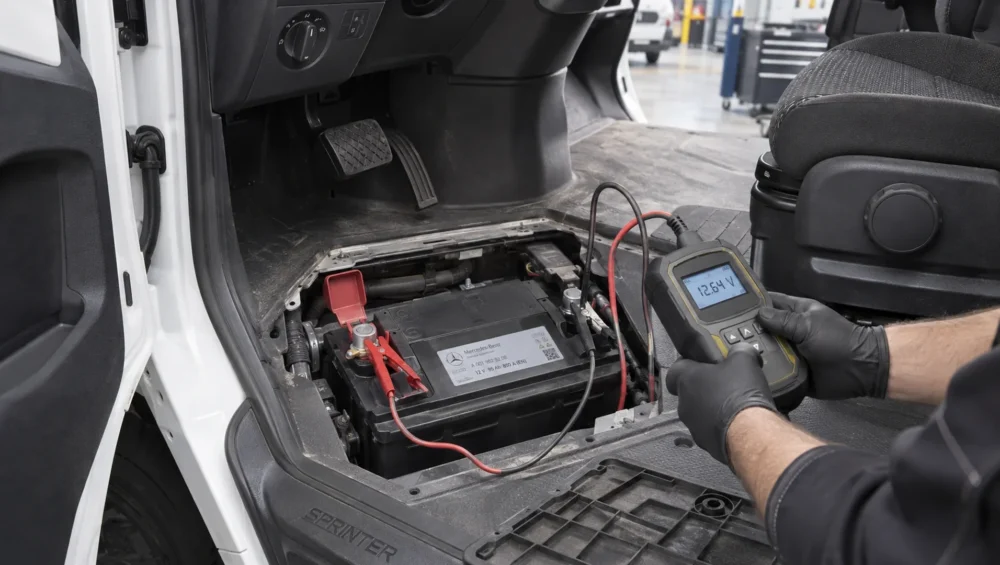
A useful assessment checks the battery alongside the starting, charging and electrical systems. One voltage reading does not explain every recurring no-start complaint. Depending on the vehicle and symptoms, the technician may assess battery condition, connections, cables, starter operation, charging performance and abnormal key-off consumption.
Battery testing needs appropriate preparation and interpretation. A low state of charge can affect the result, so the shop may need to charge the battery and reassess it. Charging-system checks should also reflect the vehicle’s design and operating conditions. Avoid diagnosing every alternator against a single voltage figure copied from an online discussion.
When investigating an electrical draw, vehicle-specific procedures matter. The technician may need to allow systems to enter their normal parked state before interpreting consumption.
Ask for the findings in the repair report: what was tested, what was abnormal, what was repaired and how the result was checked. That gives the fleet a more useful record than “battery replaced.”
Fleet Specialties provides battery, starter and alternator diagnosis and repair for commercial vehicles. Explain that the battery has already been replaced when booking the appointment.
Send the Van With a Clear Complaint History
A short, consistent record can make an intermittent fault easier to investigate. Include the unit number, mileage, battery replacement date and dates when starting assistance was needed. Drivers should record whether the engine cranked slowly, clicked, cranked normally without starting or showed no electrical response. Those are different complaints, and “would not start” may conceal the distinction.
Photograph dashboard messages when safely parked. Keep invoices for recent electrical repairs and identify any equipment that was operating when the van was last shut down. For fleets, keep those details with the unit’s repair history. Our fleet management services support maintenance coordination and repair-history tracking, helping recurring complaints remain visible when drivers change.
Preventing the Same Problem From Returning
The prevention plan should follow the diagnosis. A repaired connection, corrected installation, charging strategy or battery replacement addresses a different cause, so there is no single fix for every van.
Agree on any driver actions before the vehicle returns to service. That might include a defined accessory shutdown procedure or a manufacturer-compatible charging arrangement for vehicles parked for longer periods.
Keep the follow-up specific. Record whether the van starts normally after the same parking interval or route pattern that previously caused trouble.
Our preventive fleet maintenance guide explains how operating conditions and repair history inform service planning. If a work van keeps needing a boost, arrange an assessment with Fleet Specialties in North York. Bring the complaint history so the investigation can focus on the recurring problem.
Frequently Asked Questions
Is a normal-cranking engine that will not start always a battery problem?
An engine that cranks normally but does not start may have a fault outside the battery system. Describe the cranking behaviour accurately so the shop can select the appropriate diagnostic checks.
Can a battery warning light be ignored if the van still runs?
A battery or charging-system warning should be investigated promptly even when the engine is still running. Follow the vehicle manual’s instructions and avoid assuming continued operation means the charging system is healthy.
Should a fleet buy higher-capacity batteries for every van?
Battery selection should follow the vehicle’s required specifications and compatibility requirements. Review the actual electrical demands and manufacturer guidance before changing capacity or battery technology.
Can we boost a battery that may be frozen?
A battery suspected of being frozen should not be jump-started. Arrange professional assistance and follow the vehicle manufacturer’s instructions before attempting further starting or charging.