
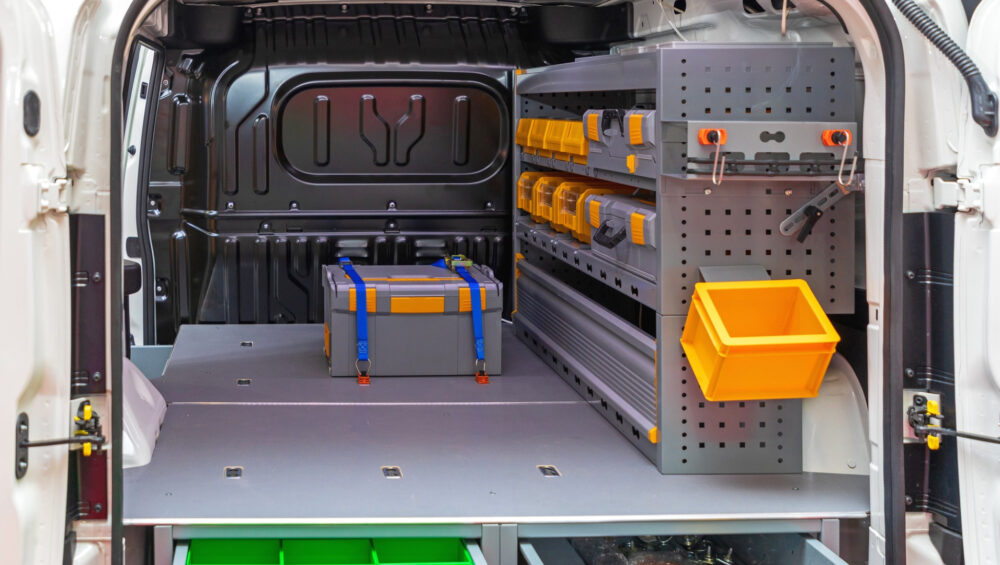
Commercial van upfitting involves installing shelving, storage systems, partitions, flooring, racks and other equipment to make a work vehicle suitable for its daily tasks. The right arrangement depends on the tools and materials being carried, how frequently employees need them and the van’s usable space and payload.
For Toronto companies operating service vans, contractor vehicles and commercial fleets, a well-planned upfit can help employees stay organized, secure equipment and use their time efficiently. Filling every wall with shelving, however, is not necessarily the best approach. The design should follow how the vehicle is actually used.
What Is Commercial Van Upfitting and When Is It Worth It?
Commercial van upfitting modifies a cargo or work van with equipment suited to the tasks it performs. Common additions include shelves, drawers, cabinets, partitions, ladder racks, flooring and lighting.
An electrician may need organized small-parts storage and secure tool drawers. A plumber may require space for fittings, larger equipment and long materials. A property maintenance crew may benefit from flexible shelving and open cargo space.
Signs an Upfit Could Help
- Employees regularly search for tools or supplies.
- Loose equipment needs safer storage and restraint.
- The van’s cargo space is difficult to use efficiently.
- Tools or materials are frequently damaged in transport.
- Vehicles are shared by employees with similar roles.
- The company is adding vans and wants consistent layouts.
An upfit is most worthwhile when it solves clearly identified daily problems. Accessories that do not help the work are simply additional cost and weight.
How to Choose Shelving, Drawers, Storage and Partitions
Start by identifying items used at almost every appointment, those needed occasionally and equipment carried only on particular projects. Store regularly used tools where employees can retrieve them without repeatedly unloading the van.
Commercial Van Shelving
Shelving works well for boxed materials, parts bins, tool cases and supplies that need to stay visible. Adjustable shelves can accommodate changing inventory, while fixed systems can suit predictable loads. Check shelf depth, rated capacity and accessibility through rear and side doors.
Deep shelves may look useful on a drawing but leave too little room to move safely through the cargo area.
Drawers and Cabinets
Drawers organize small fittings, tools and consumables. Cabinets can provide enclosed storage for expensive equipment. Doors and drawers need reliable latching so they do not open while the van is moving.
Cargo Partitions
A partition separates the cab from cargo. A correctly selected and installed bulkhead can help provide a barrier between occupants and equipment, but it does not replace the need for cargo restraints.
Flooring and Lighting
Durable flooring can protect the cargo area from wear. Interior lighting improves visibility when technicians load or unload supplies in dark parking areas or early in the morning. Any additional lighting must be compatible with the vehicle’s electrical system.
Fleet Specialties provides custom commercial vehicle upfitting, including shelves, drawers, partitions, flooring, lighting, racks and custom fabrication.
Recommended Van Layouts for Different Trades and Service Businesses
A single configuration cannot serve every business equally. Equipment inventory and daily workflow should determine the layout.
HVAC Service Vans
HVAC service technicians may need parts bins, drawers for diagnostic tools, secure storage for equipment cases and suitable ladder storage. Organize frequently used components near the main access door and account for heavy equipment and safe loading.
Plumbing Vans
Plumbers often carry many sizes of fittings, hand tools, power tools and larger equipment. Labelled bins can make supplies easier to locate, while longer materials need appropriately secured storage. Avoid designs that force employees to remove heavy objects to reach common fittings.
Electrical Contractor Vans
Electrical service vans benefit from sorting connectors, fasteners, testers, cable and specialized tools into distinct compartments. The final layout should also reflect whether workers need access through the sliding door, rear doors or both.
Property Maintenance Vehicles
Property maintenance vehicles may carry cleaning supplies, replacement parts, hand tools and occasional bulky materials. A mixture of shelving and open floor area may be more adaptable than a van full of fixed cabinets.
Delivery and Courier Vans
Delivery drivers need rapid access during repeated stops. For smaller parcels, shelving may help; for larger or varied deliveries, an open cargo area with adequate restraints may be preferable. Consider parcel dimensions, daily volume and loading order.
Weight Distribution, Payload Limits and Equipment Safety
Every shelving unit, drawer, partition and ladder rack contributes to the loaded weight of a van. The total load must remain within manufacturer ratings, including gross vehicle weight and axle limits.
Understand Vehicle Weight Ratings
Gross vehicle weight rating (GVWR) is the manufacturer’s maximum permitted loaded weight. It accounts for the vehicle, occupants, fuel, installed equipment and cargo. Upfit components consume part of the remaining payload, so available capacity should be checked using vehicle-specific information.
Cabinets installed unevenly can also affect axle loading. A design should be reviewed before ordering equipment, not only after installation.
Secure Heavy Equipment
Heavy tools and equipment need appropriately rated mounting and restraints. Cargo must not move unexpectedly during braking or cornering, and it must not block vehicle exits or necessary safety equipment.
Applicable Ontario cargo securement and inspection requirements depend on the type and use of the vehicle.
Choose Compatible Mounting Methods
Approved mounting locations vary by van model. Drilling into unsuitable structural, fuel or electrical areas can cause serious damage. Installation should follow both van-maker and equipment-supplier directions.
Custom Upfitting vs. Standard Van Storage Packages
A preconfigured package often combines commonly requested shelves and a partition for a specific van model. It can simplify purchasing and repeat installations across similar vehicles.
Custom upfitting is appropriate when a vehicle carries unusual equipment, needs dedicated fabrication or must preserve a particular area of open floor space.
Steel vs. Aluminum Shelving
Material affects total weight, price, durability and possible maintenance needs. Steel can suit demanding applications, depending on the product design. Aluminum can reduce weight, although rated capacities differ by manufacturer and product.
Compare complete systems and load ratings rather than choosing solely by material. The best option is the one that fits the actual work and vehicle limits.
What Should Businesses Consider Before Upfitting Multiple Vehicles?
Upfitting an entire fleet requires a consistent planning process, even when every van does not need an identical interior.
Standardize Where Practical
Technicians doing similar jobs may benefit from finding tools and supplies in the same place across vehicles. This can simplify replenishment, inventory and vehicle reassignment. Different departments may need different layouts.
Ask the Employees Who Use the Vans
Drivers and technicians know which tools are difficult to reach and which materials are constantly moved. Their input can prevent design choices that look efficient on paper but cause inconvenience on the job.
Confirm Vehicle Compatibility
Roof height, wheelbase, door placement and mounting points differ between vehicle models. Equipment that fits one van may not fit another, even if the vans appear similar in size.
Coordinate Installations With Operations
Businesses adding several vehicles should plan installation appointments around work schedules. Fleet Specialties’ fleet management services can support new-vehicle preparation and maintenance coordination.
How Much Does Commercial Van Upfitting Cost?
The price depends on the vehicle model, shelving type, drawers, cabinets, partition, lighting, flooring, ladder racks and any custom fabrication. Installation labour and wiring requirements also affect cost.
A basic storage package generally involves fewer components than a complex installation with custom cabinets and electrical accessories. Ask for a written quote that specifies the equipment, labour, compatibility requirements and any exclusions.
The lowest initial quote is not necessarily the best long-term value if the equipment makes supplies hard to reach or requires modification later.
Choosing a Commercial Van Upfitting Provider in Toronto
An upfitting provider should review the vehicle and the work it performs before recommending components. Be ready to discuss vehicle specifications, equipment inventory, employee access, operating needs and budget.
Ask about mounting methods, product load ratings, vehicle compatibility and installation scheduling. Added equipment must also leave necessary vehicle service areas accessible.
Fleet operators should coordinate customization decisions with their commercial vehicle maintenance and repair requirements to help preserve long-term serviceability.
Make Your Work Vans Fit the Way Your Business Operates
The right van interior makes frequently used items easy to find while protecting cargo space, vehicle payload and employee safety. A carefully planned system can make vehicle preparation more consistent across a fleet.
Fleet Specialties provides commercial vehicle upfitting from its North York facility to businesses in Toronto and the GTA. To discuss shelving, storage or custom layout needs, contact Fleet Specialties.
Frequently Asked Questions
Can an existing commercial van be upfitted, or does it need to be new?
An existing van can often be fitted with shelves, partitions and storage equipment if its condition and design support installation. A provider should review mounting locations and existing modifications before specifying components.
How long does commercial van upfitting take?
Installation time depends on the scope of equipment and any required custom fabrication or wiring. The provider should confirm a schedule after reviewing the particular vehicle and design.
Can the same shelving system be installed in different van models?
Not always. Van dimensions, wheelbase, roof height and approved mounting points can vary substantially. Some components or brackets may need to change even when the overall layout looks similar.
Does commercial van upfitting affect payload capacity?
Not always. Van dimensions, wheelbase, roof height and approved mounting points can vary substantially. Some components or brackets may need to change even when the overall layout looks similar.
Should commercial fleets use identical layouts in all vehicles?
Not always. Van dimensions, wheelbase, roof height and approved mounting points can vary substantially. Some components or brackets may need to change even when the overall layout looks similar.